By WIBayNews Staff
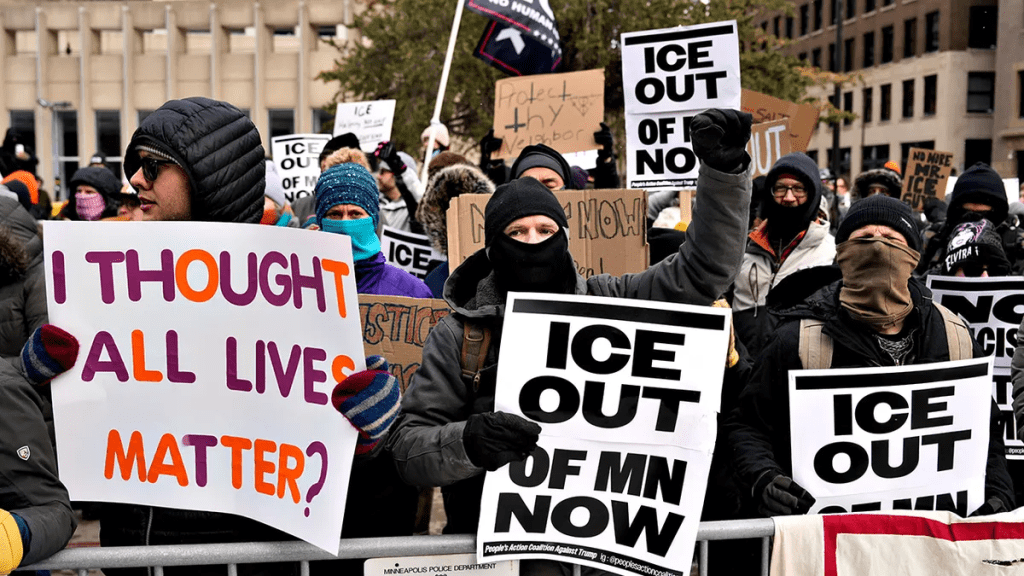
ST. PAUL, Minn. — Tensions surrounding immigration enforcement in Minnesota escalated sharply Sunday after a group of anti-ICE protesters disrupted a worship service at Cities Church in St. Paul, drawing national attention and reigniting debate over protest tactics, religious freedom, and the limits of political activism.
The disruption occurred on the morning of January 18, 2026, at Cities Church, located at 1524 Summit Avenue. Protesters entered the sanctuary during Sunday services to confront the church’s pastor, David Easterwood, who also serves as Acting Director of the St. Paul Field Office of U.S. Immigration and Customs Enforcement (ICE).
A Church Becomes the Target
According to multiple eyewitness accounts and widely circulated videos, protesters chanted slogans such as “ICE out” and invoked biblical imagery—referencing Jesus overturning tables in the temple—to justify confronting Easterwood inside the church. The interruption was brief but tense, with congregants visibly shaken and services momentarily halted.
Supporters of the protest argue that Easterwood’s dual role represents a moral contradiction, claiming churches should not be led by individuals connected to immigration enforcement. Critics counter that entering a place of worship to stage a political protest crosses a line, transforming a religious service into a battleground for ideological conflict.
“This wasn’t accountability—it was intimidation,” one church attendee said in a video shared online. “People came here to worship, not to be shouted at.”
Don Lemon on Scene, Viral Claims Follow
Former CNN anchor Don Lemon, now operating as an independent journalist, was present at the scene livestreaming the event. His broadcast reportedly drew as many as 14,500 live viewers at peak. Lemon interviewed protesters and church members alike, documenting the confrontation as it unfolded.
Despite viral claims on social media accusing Lemon of “storming” the church alongside activists, there is no evidence he led or participated in the disruption. He appears to have been covering the incident as it happened. Nevertheless, his presence—and perceived sympathy toward protesters—has fueled criticism from conservative commentators who view the coverage as amplifying radical tactics rather than scrutinizing them.
Rooted in a Broader Minnesota Flashpoint
The church disruption is part of a wider wave of protests across the Twin Cities following the January 7, 2026, fatal shooting of Renee Nicole Good, a 37-year-old U.S. citizen and mother, during an ICE enforcement operation. That incident has sparked school walkouts, marches to the Minnesota State Capitol, legal challenges by state and local officials, and renewed calls to restrict ICE activity near so-called “sensitive locations” such as schools, hospitals, and churches.
Clashes earlier this month outside the Bishop Henry Whipple Federal Building—an ICE hub in St. Paul—featured the use of pepper spray and pepper-ball munitions by federal agents, further intensifying outrage among activists and progressive clergy.
A Divided Response
Reaction to Sunday’s church disruption has been deeply polarized:
- Progressive activists describe the protest as legitimate civil disobedience against what they see as abusive and excessive federal enforcement.
- Church leaders and conservative voices argue the incident represents an alarming erosion of respect for religious spaces and civil norms, warning that normalizing such tactics invites further escalation.
- Federal officials have not commented specifically on the church incident, but continue to defend the broader enforcement surge as necessary for public safety and border security.
- State and local leaders in Minnesota are pressing lawsuits and policy measures aimed at limiting ICE’s footprint within the state.
What Comes Next
As of Sunday afternoon, no arrests or injuries were reported from the church disruption itself, though demonstrations across the Twin Cities remain active. Organizers have floated plans for larger actions, including a proposed “economic blackout” day, signaling that tensions are unlikely to cool soon.
For many Minnesotans, the episode raises a fundamental question: when political protest moves into churches and other sacred or civic spaces, does it advance accountability—or does it undermine the very social fabric protesters claim to defend?
Support Independent Journalism
Wisconsin Bay News is part of the Bay News Media Network — a growing group of independent, reader-supported newsrooms covering government accountability, courts, public safety, and institutional failures across the country.
📰 Support independent journalism that isn’t funded by political parties, corporations, or government agencies
📩 Submit tips or documents securely — if you see something wrong, we want to know
Independent reporting only works when readers stay engaged. Your attention, tips, and support help keep these stories alive.
 Wisconsin Bay News
Leave a comment