By Thunder Report / WIBayNews
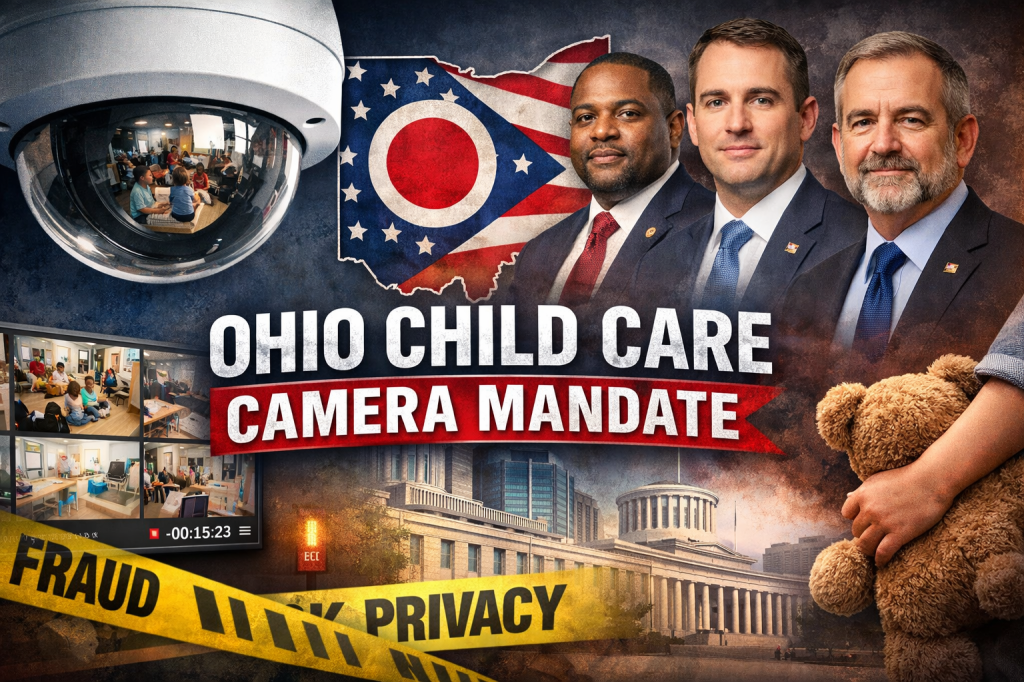
Republican lawmakers in Ohio are advancing a proposal that would require video cameras in all publicly funded child-care centers, framing the measure as a common-sense step to protect children and safeguard taxpayer dollars — while also exposing a growing divide inside the GOP over how aggressive state oversight should be.
The proposal was announced this week at a Statehouse news conference by Josh Williams and D.J. Swearingen, with backing from Ohio Attorney General Dave Yost. The legislation has not yet been formally introduced.
What the Camera Proposal Would Do
Under the draft framework described by lawmakers, child-care centers receiving public funds would be required to:
- Install cameras covering all interior and exterior entrances and common areas
- Exclude private spaces such as bathrooms, changing rooms, and offices
- Retain recordings for at least 60 days
- Provide the Ohio Department of Children and Youth (DCY) with secure, real-time and archived access
- Face immediate funding suspension or termination upon “credible suspicion” of waste, fraud, or abuse
Supporters say the system would allow for virtual attendance audits and oversight checks, reducing the need for reactive investigations after money has already been spent.
“This is about protecting kids and protecting taxpayers,” Williams said. “Ohio has a responsibility to ensure publicly funded child-care centers are safe and operating honestly.”
Yost echoed that argument, saying technology should help the state move away from a “pay and chase” fraud model that relies on audits long after alleged abuse has occurred.
Context: Fraud Claims and Political Tension
Ohio operates roughly 5,200 publicly funded child-care providers, serving more than 100,000 children daily. Concerns about fraud intensified after viral social-media allegations — originating in Minnesota and spreading nationally — claimed some providers were billing the state for children who were not actually present.
While conservative influencers have fueled the narrative through unannounced visits and online videos, state officials have pushed back, warning that claims of widespread fraud are exaggerated. In 2025 alone, Ohio conducted more than 10,000 unannounced inspections, resulting in 38 centers being shut down.
Governor Mike DeWine and senior administrators have cautioned that alarmist rhetoric could jeopardize federal funding streams if Ohio appears to be politicizing oversight rather than enforcing existing standards.
A Competing Republican Approach
The camera mandate is not the only GOP proposal on the table.
Earlier this month, lawmakers introduced House Bill 647, sponsored by Phil Plummer and Tom Young. That bill takes a narrower approach, focusing on enforcement rather than universal monitoring.
HB 647 would:
- Expand the Attorney General’s authority to investigate and prosecute fraud
- Allow DCY to immediately suspend licenses and payments upon credible suspicion
- Invest $5 million in data analytics to flag suspicious billing patterns
- Lock in attendance-based payments instead of enrollment-based funding
Plummer has criticized claims of rampant fraud as “blown out of proportion,” arguing that Ohio’s existing system is largely working and needs targeted upgrades — not blanket surveillance.
Opposition Raises Privacy and Cost Concerns
The Ohio Association of Child Care Providers has warned that mandatory cameras could place unnecessary financial and psychological burdens on providers who already operate under strict regulations.
Board chair Heidi Wilson emphasized that most centers operate “with honesty, integrity, and transparency,” and argued that surprise inspections and audits already address bad actors.
Privacy advocates have also raised concerns about state access to video footage of children, even with logging and access restrictions in place.
A Broader Debate Beyond Ohio
The debate unfolding in Columbus mirrors a national tension inside conservative policymaking: how to crack down on fraud and misuse of public funds without expanding permanent surveillance or punishing compliant operators.
Supporters of the camera proposal argue that accepting public dollars should come with heightened accountability. Critics counter that technological mandates risk mission creep and could discourage providers from participating in subsidy programs altogether.
For now, the camera bill remains in draft form, but it has already sparked a broader conversation — not just about child-care oversight, but about how far government should go in monitoring publicly funded services.
Support Independent Journalism
Wisconsin Bay News is part of the Bay News Media Network — a growing group of independent, reader-supported newsrooms covering government accountability, courts, public safety, and institutional failures across the country.
📰 Support independent journalism that isn’t funded by political parties, corporations, or government agencies
📩 Submit tips or documents securely — if you see something wrong, we want to know
Independent reporting only works when readers stay engaged. Your attention, tips, and support help keep these stories alive.
 Wisconsin Bay News
Leave a comment