By Michael Phillips | WIBayNews
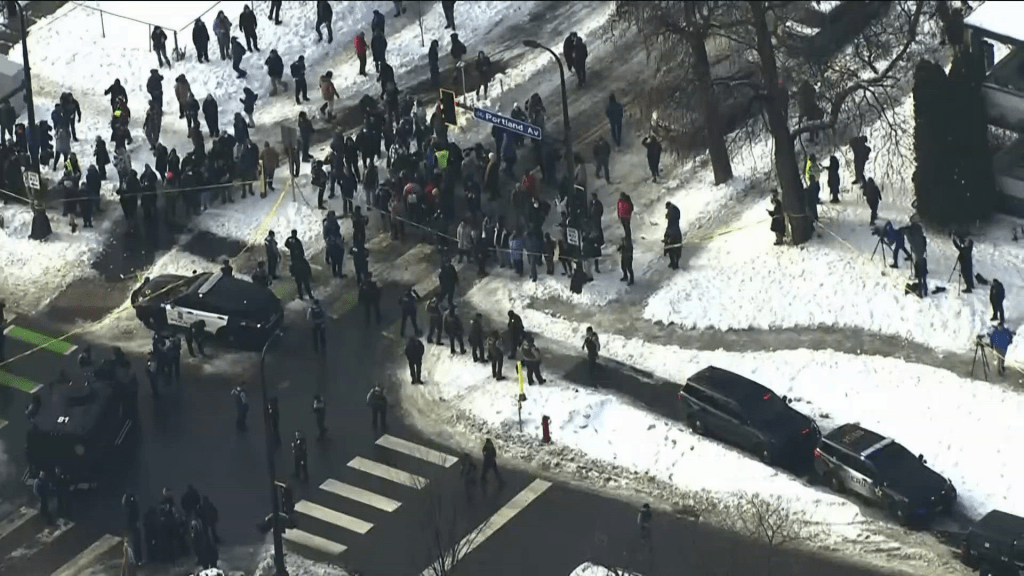
South Minneapolis became the latest national flashpoint on January 7 after an ICE agent fatally shot 37-year-old Renee Nicole Good during a large federal immigration enforcement operation—an incident now under investigation and already being litigated in the court of public opinion.
The basic outline is not in dispute: ICE agents were conducting “targeted operations” in the Twin Cities when a confrontation unfolded around Good’s vehicle, which federal officials say was blocking agents’ movement. Video circulating online shows agents surrounding the SUV, shouting commands for the driver to get out, and then firing multiple shots as the vehicle moved. Good died after the shooting.
But nearly everything else—from intent, to threat level, to who escalated first—is fiercely contested.
Two narratives, one chaotic scene
The Department of Homeland Security has argued the shooting was self-defense, describing Good as part of a hostile crowd and alleging she “weaponized” her vehicle against agents—language some federal officials have characterized as “domestic terrorism.”
Local Democratic officials have rejected that characterization in unusually blunt terms. Minneapolis Mayor Jacob Frey publicly disputed the federal account after reviewing video, calling DHS’s version “garbage,” while Gov. Tim Walz also criticized the federal messaging as “propaganda,” as state and federal authorities opened investigations.
Those investigations matter, because the short clips driving the debate can’t answer key questions: What did agents perceive in real time? What were the exact positions of agents relative to the vehicle? Was there an imminent risk of an agent being run over—or was the vehicle attempting to maneuver away? Was there any feasible alternative in the split-second before shots were fired?
Good’s mother told local media she was “an amazing human being” and pushed back on the notion that her daughter was some kind of agitator.
A center-right concern: protests that become physical obstruction
Even as investigations proceed, one fact is already clear: anti-ICE protest tactics increasingly involve direct interference with operations—especially vehicle blockades, crowding, and physical obstruction. That may be framed as “community defense” by activists, but in practice it manufactures split-second danger for everyone in the street: agents, bystanders, and the person in the vehicle.
If you intentionally block law enforcement vehicles during an active operation, you are not merely expressing dissent—you are inserting your body (and often your car) into a volatile enforcement environment. And once a vehicle is in motion with officers nearby, the risk profile changes instantly. In law enforcement training and case law alike, a moving vehicle can be treated as a potentially lethal threat, because officers can be knocked down, pinned, or run over in a heartbeat—especially on winter roads.
That doesn’t pre-judge what happened here. It does explain why protest strategies that blur the line between speech and physical interference are inherently combustible. A protest that turns into a blockade isn’t “just a protest” anymore—it is a tactical confrontation in traffic.
The danger of rhetorical escalation—especially from elected leaders
This is where political leadership matters. When public officials describe federal officers as “terrorizing our communities,” or demand they “get the f— out,” they may believe they are channeling public anger. But they are also pouring accelerant on a scene where people are already tempted to “do something” in the street—like blocking a vehicle, surrounding agents, or escalating a standoff.
Center-right critics have long argued that parts of the modern left have normalized a rhetoric of delegitimization toward law enforcement—treating agencies not as institutions to reform, but as occupying forces to resist. The predictable result is a protest culture that inches from speech into obstruction, from demonstration into confrontation.
Words don’t force anyone to step in front of a vehicle. But in a climate where officials signal moral permission for disruption, the line between “protest” and “interference” can erode quickly—particularly when tempers flare and smartphones are rolling.
Walz’s “propaganda” accusation may play well with a base primed to distrust federal enforcement, but it also risks prejudicing public judgment before investigators establish the facts. Frey’s profane denunciations may communicate frustration, yet they also tell activists—implicitly—that disrupting federal activity is a civic good.
What accountability should look like
A serious country should be able to hold two ideas at the same time:
- Federal agents must be held to a high standard on use of force, especially when operating in civilian neighborhoods under intense scrutiny. If investigations determine the threat was not imminent—or that the encounter was unnecessarily escalated—there must be consequences.
- Activists and elected officials must stop normalizing physical interference with enforcement operations. If you believe ICE tactics are wrong, challenge them politically, legally, and electorally. Don’t turn city streets into confrontation zones where a car becomes a proxy weapon, intentionally or not.
This case will likely hinge on the details investigators can establish beyond short video clips: distance, angles, speed, positioning, commands, and whether agents had safer options in the moment. Until then, the public deserves less spin—especially from officials whose words shape public behavior—and more discipline in separating facts from faction.
The bigger point: a society can’t function on street-level vetoes
Whatever one thinks of the current administration’s immigration posture, the United States cannot operate on a principle of street-level veto—where the loudest crowd, the most disruptive blockade, or the most viral clip substitutes for law.
If activists want to change policy, they have tools: elections, litigation, legislation, and journalism. When protest becomes physical obstruction, it narrows the time and space for calm decision-making—and increases the odds that someone dies, including the very people activists claim to defend.
That is not “community safety.” It is a recipe for tragedy.
Support Independent Journalism
Wisconsin Bay News is part of the Bay News Media Network — a growing group of independent, reader-supported newsrooms covering government accountability, courts, public safety, and institutional failures across the country.
📰 Support independent journalism that isn’t funded by political parties, corporations, or government agencies
📩 Submit tips or documents securely — if you see something wrong, we want to know
Independent reporting only works when readers stay engaged. Your attention, tips, and support help keep these stories alive.
 Wisconsin Bay News
Leave a comment