
By Michael Phillips | Wisconsin Bay News and Father & Co.
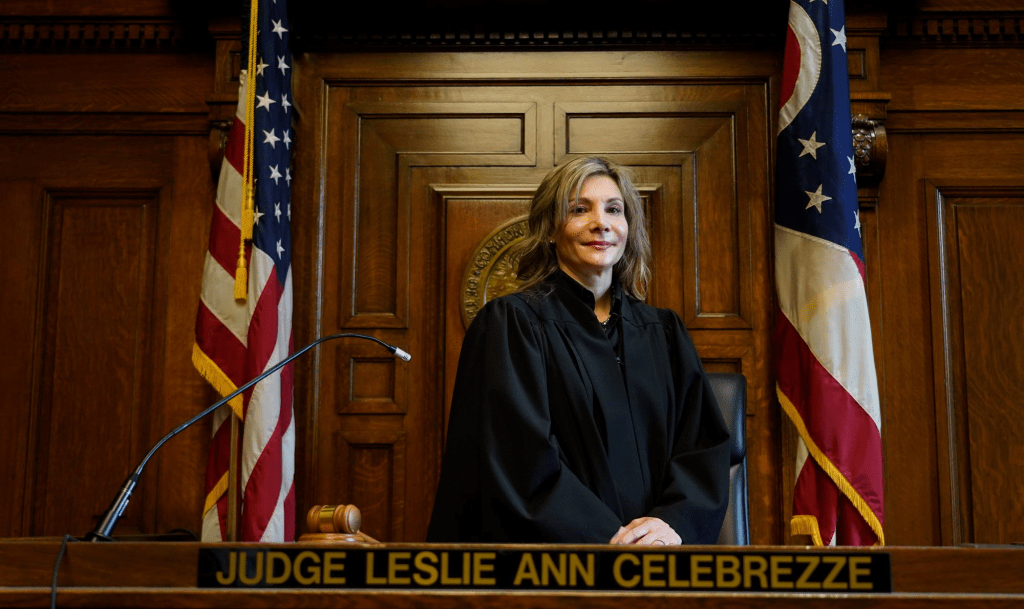
The resignation and felony charge of Leslie Ann Celebrezze, a longtime judge on Ohio’s Cuyahoga County Domestic Relations Court, has sent shockwaves through the family-law community nationwide—raising troubling questions about integrity, favoritism, and unchecked power in courts that already struggle to maintain public trust.
Celebrezze stepped down on December 22, 2025, after being charged with tampering with records, a third-degree felony. Prosecutors allege she falsely documented that a high-asset divorce case had been randomly assigned to her docket, when in fact she manually kept the case for herself—violating court rules designed to ensure neutrality and fairness.
For families navigating divorce, custody, and domestic relations matters—often at their most vulnerable—this case strikes at the heart of confidence in the judicial process.
A Dynasty on the Bench, and a Breakdown in Safeguards
Celebrezze’s career was shaped by one of Ohio’s most prominent legal families. She succeeded her father, James Celebrezze, in the same domestic relations judgeship in 2008, continuing a multi-generational legacy that includes Ohio Supreme Court justices, legislators, and federal officials.
But legacy, critics argue, may have blurred accountability.
According to court filings and investigative reporting, Celebrezze used her authority as administrative judge to bypass random case assignment, steering complex and lucrative divorce cases to herself—often after other judges recused. She then repeatedly appointed Mark Dottore, a longtime personal associate, as court receiver.
Dottore’s companies collected nearly $500,000 in fees from litigants across these cases, including more than $413,000 in a single divorce. Those fees were paid not by the state—but by families already locked in costly legal battles.
Undisclosed Relationship, Undisclosed Costs
The scandal deepened when evidence emerged of an undisclosed personal—and by Celebrezze’s own admission, romantic—relationship with Dottore. Private investigator photos captured the two kissing and visiting each other’s homes and offices. Celebrezze later acknowledged she was “in love” with Dottore during the period in question but failed to disclose the conflict.
In family courts, where judges wield extraordinary discretion over finances, custody, and parental rights, undisclosed conflicts are not technical violations—they are foundational breaches.
When judges select friends or romantic partners for lucrative court appointments, it undermines the appearance and reality of impartial justice.
Retaliation and a $400,000 Settlement
The controversy was brought to light largely through investigative journalism. In 2023, Celebrezze’s former judicial assistant, Georgeanna Semary, provided public records to reporters examining the judge’s appointment practices.
Semary later alleged retaliation, claiming she was demoted and given a pay cut. In December 2025, Cuyahoga County quietly approved a $400,000 settlement, adding taxpayer cost to a scandal already eroding confidence in the system.
Criminal Charges and a Lingering Federal Probe
The tampering charge—filed “by way of information,” often signaling an anticipated guilty plea—carries a potential sentence of up to three years in prison. Celebrezze’s arraignment was scheduled for December 23, though no outcome has yet been publicly reported.
Separately, an ongoing FBI public corruption investigation has been examining records dating back to 2008, including court appointment practices and receiver billing. While no federal charges have been announced, the probe remains active.
The Ohio Board of Professional Conduct has already recommended a two-year suspension of Celebrezze’s law license, citing an “extensive pattern of misconduct.” The Ohio Supreme Court has yet to issue its ruling.
Her vacant seat will be filled by appointment from Mike DeWine.
Why This Matters Beyond Ohio
For parents, especially fathers who already view domestic relations courts with skepticism, this case confirms long-held fears:
that family courts operate with too little transparency, too much discretion, and too few consequences for insiders who violate ethical boundaries.
Domestic relations courts decide who sees their children, who pays what, and who walks away financially ruined. When judges manipulate assignments or appoint close associates to extract massive fees from litigants, it reinforces the belief that the system is stacked against ordinary families.
This is not just an Ohio problem. Across the country, family courts rely heavily on receivers, guardians ad litem, evaluators, and other appointed professionals—often with minimal oversight and opaque billing practices.
Restoring Trust Requires Structural Reform
Celebrezze’s resignation closes one chapter but leaves a larger question unanswered:
How many similar practices go undiscovered?
If trust in family courts is to be restored, reform must go beyond individual accountability. That means:
- Enforcing truly random case assignment
- Mandating full disclosure of personal and financial conflicts
- Increasing transparency around court-appointed professionals
- Establishing independent oversight mechanisms
Until those safeguards are strengthened, stories like this will continue to erode confidence in institutions meant to protect families—not profit from them.
For concerned citizens watching from Wisconsin and beyond, the lesson is clear: when integrity fails in family court, the damage is personal, permanent, and profound.
Support Independent Journalism
Wisconsin Bay News is part of the Bay News Media Network — a growing group of independent, reader-supported newsrooms covering government accountability, courts, public safety, and institutional failures across the country.
📰 Support independent journalism that isn’t funded by political parties, corporations, or government agencies
📩 Submit tips or documents securely — if you see something wrong, we want to know
Independent reporting only works when readers stay engaged. Your attention, tips, and support help keep these stories alive.
 Wisconsin Bay News
Leave a comment