A Look at What Really Happened — And Why It Matters Beyond Indiana
By Michael Phillips | WIBayNews
In a political climate where party unity often seems enforced rather than earned, Indiana just delivered a rare reminder: state legislators ultimately answer to their own voters, not the White House.
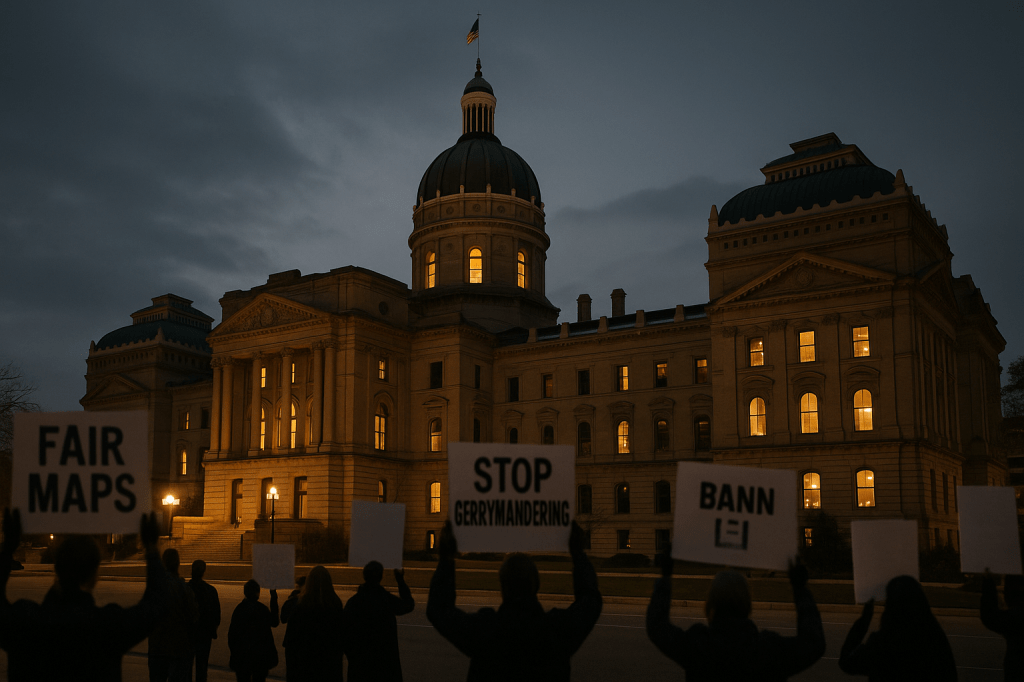
On December 8, 2025, during a special legislative session in Indianapolis, the Republican-controlled Indiana State Senate voted down a sweeping congressional redistricting bill backed aggressively by President Donald Trump. The bill would have dismantled Indiana’s two remaining Democratic seats—held by Reps. André Carson and Frank Mrvan—and created a 9–0 GOP sweep in the state’s U.S. House delegation.
Instead, twenty-one Republican senators broke ranks and joined Democrats to block the proposal, handing Trump one of the most unexpected defeats of his second term.
For Wisconsin readers trying to understand the shifting Midwest political map—and the growing tension between national power and local control—this moment in Indiana is worth examining closely.
What Trump Wanted: A Hard Push for a 9–0 GOP Map
Indiana currently leans strongly Republican (7–2 in its congressional delegation), but Trump and national party strategists saw an opportunity: eliminate the last Democratic districts through aggressive mid-decade gerrymandering.
The goal wasn’t subtle. A 9–0 map in Indiana would:
• Add 2–3 guaranteed GOP seats nationally.
• Reduce Democratic footholds in the Midwest.
• Strengthen Republican odds in the 2028 fight for the House majority.
Vice President JD Vance, Speaker Mike Johnson, and senior White House officials made multiple trips to Indianapolis to pressure reluctant senators. Trump himself called and criticized holdouts as “disloyal” and “RINOs.”
But the pressure campaign didn’t just involve political arm-twisting. According to the Politico report, senators faced a wave of alarming harassment:
• Pipe bomb threats to offices and homes.
• Swatting incidents, where police were falsely directed to lawmakers’ residences.
• Unsolicited late-night deliveries, intended to intimidate families.
The fact that such tactics became part of a redistricting battle should alarm citizens across the political spectrum—including here in Wisconsin.
Why Indiana Republicans Said No
If this were simply about resisting Trump, the story would be easy to write. But the reality is more nuanced and more important.
Many Indiana Republican senators made it clear:
this wasn’t about opposing the president; it was about protecting Indiana from excessive federal interference and avoiding an overreach that voters might punish.
Key reasons cited:
1. Respect for State Sovereignty
Legislators objected to what they viewed as Washington dictating how their state should draw its own congressional lines. Some described the White House’s involvement as “D.C. bullying.”
2. Legal Vulnerability
The proposed map would almost certainly have triggered lawsuits under the Indiana Constitution’s ban on explicitly partisan gerrymanders. Even some conservative legal scholars warned it wouldn’t survive review.
3. Backlash from Independent and Suburban Voters
Senators reported overwhelming public concern at town halls—particularly in swing counties—where voters expressed exhaustion with political gamesmanship. Many didn’t want the state plunged into years of litigation and instability.
4. Safety and Decency
Harassment targeting families—especially swatting—crossed a red line for several lawmakers. As one Republican senator openly stated during debate:
“I won’t reward tactics that terrorize my wife and children.”
When the vote came, senators acted with something increasingly rare: local judgment informed by local voters, not national command-and-control politics.
What This Means for the Midwest
1. A Warning Shot for National Parties
Indiana’s stand suggests that even in deeply red states, top-down political strategies have limits. State lawmakers are listening to their communities—and they know those communities dislike extreme map manipulation.
2. Ripple Effects Across the Region
The defeat has already slowed similar redistricting pushes in Ohio and North Carolina. Republican legislators in those states, seeing the blowback, are reassessing whether these battles are worth the political cost.
3. Democrats Gain Breathing Room
While not a sweeping victory for Democrats, keeping the Carson and Mrvan districts intact gives the party a strategic foothold in the Midwest—especially as national competitiveness tightens.
4. New Questions About Trump’s Second-Term Influence
Trump maintains strong support among GOP voters nationwide. But this episode shows that his direct authority over state legislators is not absolute, especially when local interests or legal risks conflict with national goals.
For a region like the Midwest—where politics remains more neighbor-driven than personality-driven—that distinction matters.
Why This Matters for Wisconsin
Wisconsin’s own political map battles routinely dominate headlines. Court challenges, proposed reworks, and partisan tensions have increasingly nationalized what used to be state-level debates.
Indiana’s vote offers a few reminders:
• Local control still matters, even under pressure from national leaders.
• Harassment and intimidation have no place in legitimate political disagreement, regardless of party.
• Mid-decade redistricting carries serious legal and political risks.
• State legislators serve their constituents—not the White House, whichever party occupies it.
As Wisconsin heads into 2026 and 2028—with redistricting lawsuits and legislative reform debates looming—Indiana’s example may prove instructive. Fairness, stability, and local accountability remain top concerns for voters across the Midwest.
The Bottom Line
Trump’s failed redistricting push in Indiana was not simply a political loss. It was a rare moment when state-level Republicans reasserted an older conservative principle: decisions about local representation should be made locally, even when national leaders disagree.
At a time when political pressures are rising, and intimidation is becoming disturbingly commonplace, Indiana’s Senate drew a bright line. And in doing so, it showed that the health of American democracy may ultimately depend less on Washington—and more on statehouses willing to stand on principle.
 Wisconsin Bay News
Leave a comment